Friday, January 21, 2005

COMICS: Wed. 1/19/04

Madrox: This final issue wrapped things up better than I'd expected, but I still can't say the mini-series as a whole was entirely successful. There were some good character bits, but I just didn't care about the story at all, neither the main one involving Jamie nor the side-plot involving Rahne. I would sign on if Peter David established a new ongoing series with these characters, as the last part of the issue suggests will happen, but only because I know David can create great, interesting, funny stories with the characters, not because of any particular love for this mini.

Plastic Man: Had its moments, but mostly it felt like a rehashed Tom & Jerry cartoon. Hilarious punchline to the whole thing, though.

Wanted: Mark Millar finally brings the mini-series to a close with an interesting, fourth wall-breaking meta-premise (at least, the way I choose to read it): the shift to grim and gritty comics in the mid-to-late-80s actually occurred because the supervillains of the world defeated the pure and noble superheroes once and for all. All the brightness and fun of the comic book universe were replaced by darkness and deviance because the bad guys were victorious in remaking the world in their image. This, coupled with the cover's excellent mockery of Marvel's crass "Who's Next?" chart for Avengers: Disassembled:

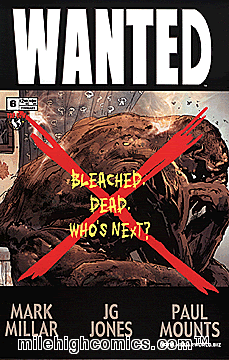

...were highlights of a generally clever and certainly very different comic. The tears-and-teddy-bears parts of the story were heavy-handed, and wildly out of synch with the overriding cynical brutality of the rest of the issue and the mini-series as a whole, but things got back on track in the end, especially with Millar's giant "fuck you" to the reader on the final page. I'm still not a huge Millar fan, and this comic was sometimes hard to take, with its celebration of the concept of "freedom of choice" being used to justify rape, murder, and the general degradation of the species, but overall it was intriguing, inventive, and well-crafted.

Haven't read yet: Powers and Invincible. I also picked up the first Gotham Central TPB, continuing on my recent Ed Brubaker buying spree. Last week, I got the third collection of his excellent Catwoman series; terrific writing, especially in the second half of the book, which illustrated the breakdown of the characters' relationships following the tragic events of the first half, but good lord was the artwork in that second half awful. It was Javier Pulido's work, and it was just wretched. He's the reason I could never get into Peter Milligan's Human Target series -- I love Milligan's writing, but I could not stomach the artwork. I hate, hate, hate Pulido's art. Hate it.

And I got the collection of Charles Schulz's other cartoon, It's Only a Game. These were one-panel sports and games-related comics Schulz co-produced with Jim Sasseville from 1957 to 1959. I hadn't bought it before because, honestly, it hadn't looked very interesting, but I impulse-bought it this week. And after paging through it, I see my first instinct was right -- it's not very interesting at all. Sure, it's neat to see Schulz draw adults, but the humor is very weak, and, as a gag-based strip, there are no recurring characters or developing themes to hook me into it. I'm glad I have it, out of a completist impulse, but it's simply not very good.

Labels: , , , , , , ,

Wednesday, November 17, 2004

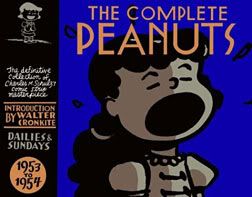
BOOKS: The Complete Peanuts 1953-1954

The Complete Peanuts 1953-1954 is the greatest book I've read since The Complete Peanuts 1950-1952.

There are some flaws with the book. The reproduction on some of the strips is unavoidably of very poor quality; pristine strips from this era, most of which were never reprinted in book form, are difficult to find. In fact, as a note in the back of the book indicates, it was completely impossible to find the top tier of one Sunday strip. Book designer Seth had to create it from scratch. When I read that, I thought it meant he had to redraw it from a copy of the strip that was so bad they couldn't print it, but no -- those original panels really no longer exist, and Seth pieced together elements from other Schulz originals to make a passable fake. (It's a golfing strip, and if you're paying close attention, you can find the pieces he cobbled together on the page in other golfing strips throughout the book, such as the golf ball rolling in the hole with a "PLUNK!")

In these early strips, Peanuts had yet to fall into the artistic routine of later years. The art is much more experimental; scenes are shown from multiple interesting angles, rather than the straight-ahead or 90-degree profile that became the trademark of the strip. And Schulz often meshed different artistic styles in the same strip; in a series of strips involving Lucy entering a golf tournament, the adults in the crowd (grown-ups in a Peanuts strip!!) were drawn with much more realism and detail than the cartoonish children. Same with Snoopy and birds; the dog is very cartoonish (though much less so than he would become), and the birds are very realistic -- no Woodstock-type birds in these early years.

The characters and their brand of humor is still developing here. Charlie Brown is mischievous and egotistical as frequently as he is insecure; he's not the lovable loser in all things (he even scores a run in baseball), but he's getting there. Linus is still crawling, but he gets his security blanket in this volume (which Charlie Brown calls a "security and happiness blanket"). Pig-Pen first appears, as does the loud-talking Charlotte Braun, whom I had never heard of before reading this book -- I guess she didn't stick around long. And Lucy has taken center stage, with her fuss-budget personality blooming, pushing Violet, Patty, and especially Shermy to the sidelines. And you can see the designs of the characters becoming finalized toward the end of the book. Most noticeably, Charlie Brown's expression becomes much less wide-eyed and cherubic.

As for the humor -- it still needs some work. There are an awful lot of running gags, most of which fall flat. Charlie Brown is a budding comic strip artist, who just can't get Schroeder to appreciate his humor. Snoopy is baffled by some object for four wordless panels. Lucy counts stars, or raindrops. But even she couldn't count the number of strips in which she complains about something Charlie Brown is bringing her, only to wind up with that something on her head. The mud pie gags are still there, but they begin fading out toward the end of the book, to be replaced by house-of-cards gags. Writing on fences pops up a great deal, as do building blocks. And when frustrated by something, Charlie Brown is more likely to say, "That's the way it goes," rather than "Rats!" (I don't think "Good grief!" has even entered his vocabulary yet.)

But in the final couple months collected here, you can see the beginning of the classic age of Peanuts. In the next couple years, the strip would solidify its format, and take off in popularity, and Schulz would commence a good twenty, twenty-five years of pure comic brilliance. Mid-50s to late-70s, that was the peak of Peanuts, which in my mind means the peak of all comic strips. I can't wait for the next volume (scheduled for April 2005).

Labels: , ,

Tuesday, October 19, 2004

Potpourri

I really have no idea what to write today, but since my traffic is up recently, and it only takes one day off to be totally forgotten and drop back down to double digits in hits (yes, I actually worry about that kind of thing, I'm a mess), I'll just write whatever the hell comes to mind.

--I got the first season DVD box sets for both The Simpsons and Futurama yesterday. I hadn't gotten them before because A) I don't think the first season of The Simpsons holds up very well at all, and B) I've seen the first season of Futurama plenty enough in reruns on the Cartoon Network. But that Amazon sale ($15.99 each!) was too much to resist.

--Next up from Amazon: The Complete Peanuts 1953-1954 and Random Zits. I loves my comic strips! Too bad the new Doonesbury isn't out for another couple weeks, or I'd have added that to my order, too.

--Comic strips that don't get collected in books anymore, but should: One Big Happy. Drabble. The Fusco Bros.

--You know what comic strips I don't love?
  • Fox Trot. Hate it. Same structure every damn strip: a line in panel one gets repeated in panel four, either by a different character or in a different context. So uninventive and predictable.
  • Get Fuzzy. Having the dog actually say "Ha! Ha! Ha!" doesn't make the punchlines any funnier. In fact, they're not funny at all.
  • Non Sequitur. Seriously, does anybody like that crap?
--If I had a regular newspaper subscription, I would revive the Baltimore City Paper's "Funny Paper" column on this blog every Friday. For those of you who have never run across it online, it was a weekly critique of the Baltimore Sun's daily comic strips -- a very harsh and hilariously meticulous critique. Sample from the last time the column ran (last February):

MOMMA: Wednesday, Momma mistakes a door-to-door scythe, cassock, and sandals salesman for the Grim Reaper. Sandals? The Grim Reaper isn't a fuckin' hippie!
There are tons of columns in the archives, go check 'em out. And maybe I'll start getting my local paper, just to have a guaranteed post once a week. As opposed to this rambling mess today.

Labels: , , , , , , ,

Friday, September 17, 2004

Me Want

Pictures and Amazon links aplenty!


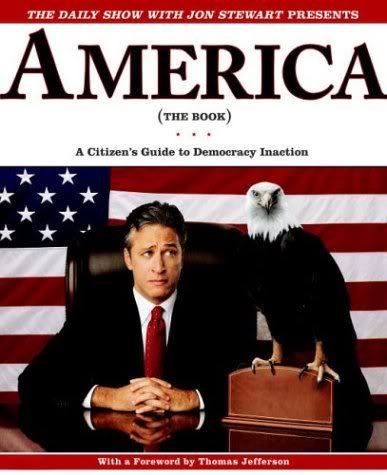
The Daily Show with Jon Stewart Presents America (The Book): A Citizen's Guide to Democracy Inaction. Release date: September 20, 2004.


Stephen Lynch: Live at the El Rey. Release date: September 28, 2004. Stephen Lynch is one of the funniest comedians I've ever heard. His songs are generally very, very dirty, and very, very funny. Thanks to Dorian for making me aware of this one. And thanks to Reid for letting me know that the DVD does include possibly his funniest, most likely his darkest, and definitely his most controversial song ever, "Kill a Kitten". (Sample lyric: "To quote the Bible cuz that's where it's written/'If ye loveth Jesus ye must kill a kitten.'")


The Complete Peanuts 1953-1954. Release date: October, 2004.


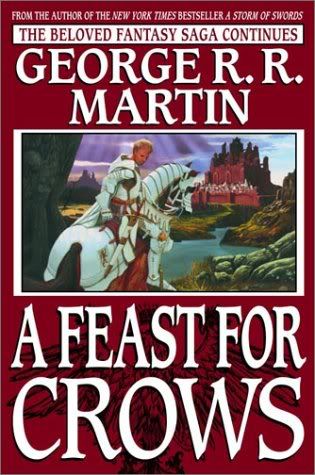
George R. R. Martin: A Feast for Crows. Release date: possibly December 30, 2004. Or, considering that over the last four years a good half dozen release dates have come and gone: possibly never.

DVDs for Scrubs and Deadwood: not yet released. No current plans for release. Dammit.

Labels: , , , , , , ,

Tuesday, August 03, 2004

COMICS: PvP vs. the World Crime League

I love comics. But I love comic strips even more. I'd gladly trade away Spider-Man for my daily fix of Doonesbury. If it came down to Batman or Dilbert, Batman would be out the door so fast his freakin' cowl would spin. If I had to choose between Peanuts and... well, no need to even finish that sentence. I would give up every comic ever for Charlie Brown and Snoopy.

What's got me thinking about this is one man's plan to renovate the comics page: Scott Kurtz's post about comic strip syndication. Kurtz, as you may or may not know, is the creator of the fine and funny online comic strip PvP. And in a few short paragraphs, he's put forth an argument for a comics page business model that's so radical, so revolutionary, so crazy, that it just might destroy the comic strip syndicates, and completely change the world of comic strips.

I'm not going to go into his plan here; if you're interested, he explains his ideas much better than I could. He's got some sound logic and some grand ideas. But he also has some holes in his proposal; primarily, he totally fails to consider that, even if the newspapers want the syndicates to fall, many of the comic strip creators will not. Even with the promise of ownership of their own creations, as well as 100% of the profits from the books and assorted other merchandising the strips may spawn, many creators will still prefer the safety and security of the syndicates to a free market. For one thing, not every strip has a lot of merchandising, nor even the possibility of it; for every Garfield, there are dozens of Mr. Boffos or Drabbles or One Big Happys, for which there's barely a market for the books, let alone the kind of greeting card/birthday hat/plush toy merchandising that would generate enough money to make abandoning the syndicates worthwhile.

I said he fails to consider that fact, but perhaps he has considered it, and discarded it. For one thing, he is presupposing that the comics page is ready to self-destruct on its own, that newspapers are already close to rejecting the syndicates and shutting down their comics pages altogether. And it sounds like his plan is for a younger, newer crowd of strips to take over the comics page, to hell with what came before. And while it may be fine for Get Fuzzy to suddenly be in competition with hundreds of free (or much cheaper) new comic strips, and while it may also be fine for relics like Dennis the Menace, The Family Circus, Marmaduke, and so forth to be permanently retired, what about those established but deserving strips that suddenly find themselves unable to compete in such a market? For Better or For Worse might be a good example here. I think it's still a decent strip, though clearly of another generation. Would it suddenly be lost in the shuffle?

All this is idle speculation, obviously; it may even sound like I'm against Kurtz, but I'm not. The truth is, it's more than likely that Kurtz won't change anything with his plan, and even if he does, it will be in slow and minute increments. But I admire him for proposing such an ambitious plan. And I'm hoping that if he (and hopefully other online cartoonists) and the newspapers successfully take a stand against the stranglehold the syndicates have on the comics page, that one of my fondest dreams may at long last be realized:

Cathy will finally die.

Labels: , , , , , , , ,

Weblog Commenting and Trackback by HaloScan.com